



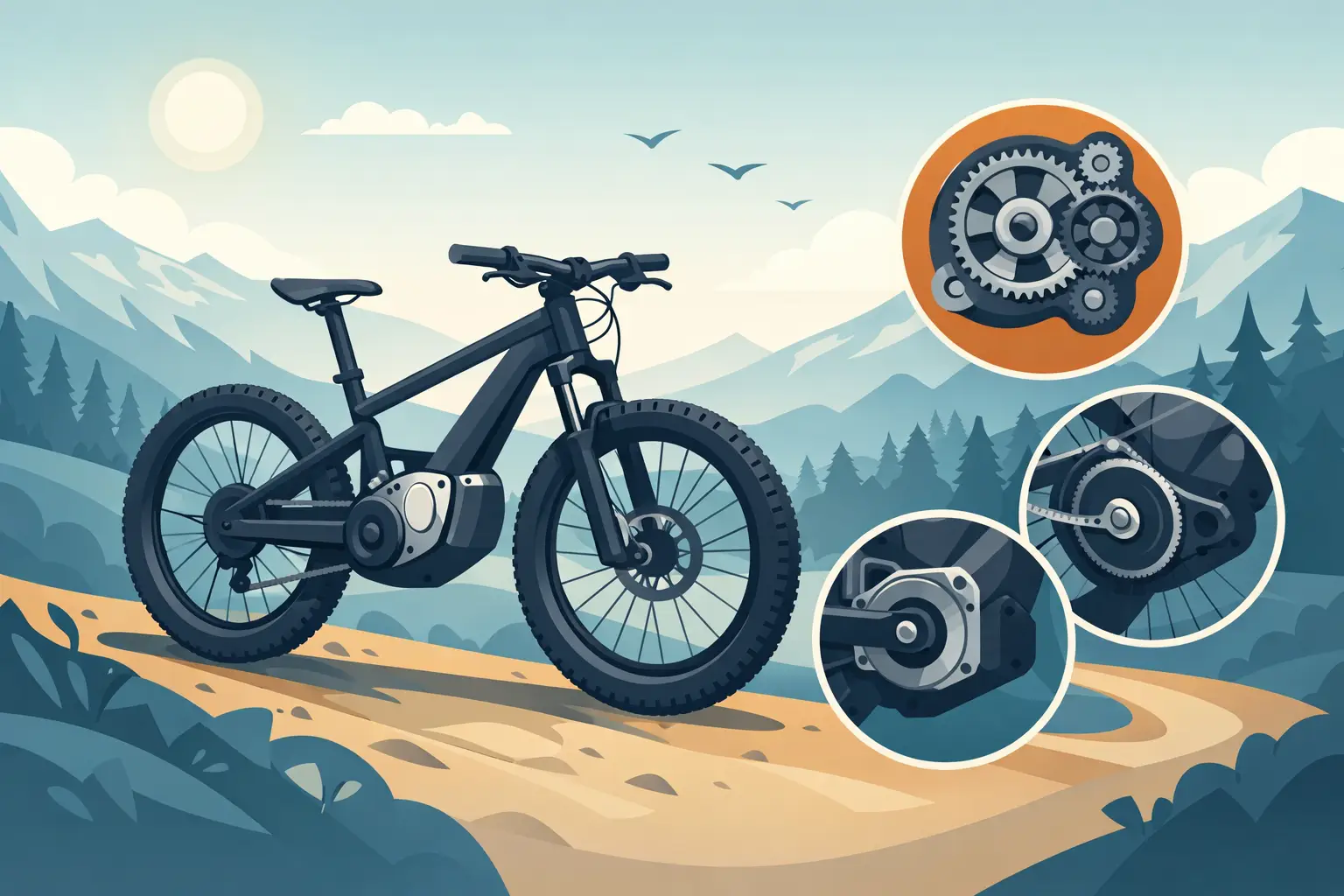
You notice it the first time you sprint out of a rough corner. The bike feels unusually calm at the rear wheel, quieter through the chatter, and less exposed underneath. If you have ever asked what is a gearbox mountain bike, the short answer is simple: it is a mountain bike that houses its gears in a sealed gearbox near the bottom bracket instead of using a traditional rear derailleur and cassette.
That definition is accurate, but it barely explains why experienced riders are paying attention. A gearbox bike is not just a different way to shift. It changes mass distribution, reduces drivetrain exposure, and can materially alter how a bike behaves on rough ground. For riders who care about consistency, durability, and refined ride feel, that matters.
What Is a Gearbox Mountain Bike in Practice?
On a conventional mountain bike, the gearing system is spread across the drivetrain. You have a derailleur hanging at the rear axle, a cassette on the back wheel, and a chain moving across exposed sprockets. It works well, shifts quickly, and remains the dominant setup for good reason. It is also vulnerable to impact, contamination, and wear.
A gearbox mountain bike relocates the gearing into a compact unit integrated around the crank area. The rear derailleur disappears. The cassette disappears. In many modern implementations, the chain is replaced by a carbon belt drive. The result is a cleaner and more centralized drivetrain architecture.
This is why gearbox bikes attract serious attention in enduro, gravity, and technical trail riding. The concept is not novelty for its own sake. It is a deliberate engineering choice aimed at ride quality and long-term ownership.
Why Riders Consider a Gearbox Instead of a Derailleur
The most immediate advantage is protection. A derailleur sits low and exposed, exactly where rocks, roots, and trail debris can damage it. Anyone who rides hard in alpine terrain or through rough winter conditions understands the cost of that vulnerability. A gearbox sits higher, tucked into the frame, away from direct impact.
Then there is maintenance. A sealed gearbox is far less exposed to mud, grit, and water than an open derailleur drivetrain. Wear is reduced, service intervals are different, and day-to-day upkeep becomes simpler, especially when paired with a belt drive. For riders who spend more time on demanding trails than in the workshop, this is a genuine advantage.
The third reason is handling. Moving drivetrain mass from the rear wheel to the center of the bike changes the bike’s dynamic behavior. Less unsprung mass at the rear wheel can help suspension respond more freely to successive impacts. More centralized mass can make the bike feel calmer and more planted when speeds rise and terrain gets violent. It is not magic, and frame design still matters enormously, but the underlying benefit is real.
How a Gearbox Mountain Bike Works
Inside the gearbox, multiple gear ratios are contained in a sealed mechanism. Rather than the chain physically moving across cogs at the rear, the rider selects internal gears within that unit. The drive then transfers power to the rear wheel through a single front and rear pulley or sprocket.
One of the most established systems in this category is the Pinion gearbox. In a high-performance mountain bike application, a setup such as the Pinion C1.12 provides a wide gear range and evenly stepped ratios in a compact central package. When paired with electronic shifting, the system gains another layer of precision. Shifts are controlled rather than improvised, and the drivetrain experience feels distinctly engineered rather than merely assembled.
That centralization also affects frame design. A bike built around a gearbox is not a standard frame with a different parts kit. It has to be engineered for the system from the start. Kinematics, packaging, belt tension, chainstay layout, and frame stiffness all need to work together. On a well-executed platform, the benefit is not just the gearbox itself but the coherence of the whole bike.
The Ride Feel Is Different
This is where the conversation gets more interesting. Gearbox bikes do not simply ride like derailleur bikes with lower maintenance. A good one has a character of its own.
With less weight concentrated at the rear axle, the back wheel can feel more reactive over square-edge hits and repeated impacts. Riders often describe the bike as feeling quieter and more composed, especially on rough descents where derailleur slap and drivetrain movement usually add noise and distraction. The frame can also look and feel cleaner because there is less exposed hardware hanging off the bike.
Climbing behavior depends on the complete platform, not just the gearbox, but there are practical benefits. Because the gearing is internal, shifting can be highly controlled. Some systems also allow shifting while coasting or under reduced load conditions where a derailleur setup might be fussier. That can help on technical climbs where cadence and traction are constantly changing.
Still, it depends on expectations. If you want the lightest possible race-day build for smooth courses and easy service from any shop, a conventional drivetrain remains compelling. A gearbox makes more sense when durability, consistency, and descending composure rank higher.
Trade-Offs You Should Know
A gearbox mountain bike is not automatically the right answer for every rider. The most obvious trade-off is weight. Gearbox systems are typically heavier than a premium derailleur drivetrain, at least in isolation. The complete bike can offset some of that through smart design, but anyone comparing build sheets will notice the difference.
There is also feel. Internal gear systems can transmit power differently than a derailleur setup. Some riders love the damped, controlled character. Others prefer the familiar immediacy of a conventional drivetrain. Neither reaction is wrong. This is one of those areas where a test ride matters more than forum opinions.
Cost is another factor. A properly engineered gearbox bike is not a budget product. The system itself is specialized, the frame is purpose-built, and the audience is typically looking for a premium ownership experience rather than lowest entry price. For many riders, that investment makes sense only if they value the full package: handling, durability, exclusivity, and reduced maintenance.
Finally, compatibility and support are more specialized. While top-tier gearbox systems are increasingly proven, they still sit outside the mainstream. Buyers should be comfortable with a more considered purchase, not an off-the-shelf commodity decision.
Who a Gearbox Mountain Bike Is Really For
The best candidate is not just someone who wants something different. It is someone who can feel and appreciate the difference.
If you ride hard in rocky terrain, destroy derailleurs, and prioritize descending stability, a gearbox bike is easy to justify. If you ride year-round in wet, abrasive conditions and dislike replacing drivetrain parts, the ownership case becomes stronger. If you are building a premium bike around long-term use rather than seasonal upgrades, the logic is stronger still.
It also appeals to riders who care about engineering integrity. A gearbox platform has a more intentional quality when executed well. It feels less like a collection of components and more like a complete machine designed around a singular idea. That is a meaningful distinction in the premium segment.
For riders chasing the lightest XC setup or the cheapest path into mountain biking, this category is probably not the answer. But for experienced trail and enduro riders who value smoothness, durability, and technical refinement, it is a serious option.
What Is a Gearbox Mountain Bike Compared With an eMTB?
This is where some confusion appears. A gearbox mountain bike is defined by its drivetrain layout, not by whether it has a motor. Some gearbox bikes are fully human-powered. Others combine a gearbox with an electric drive system.
That combination can be especially compelling. A centrally mounted motor and centrally mounted gearbox create a highly integrated platform, often with impressive weight distribution and clean design. But a gearbox bike does not need to be an eMTB, and an eMTB does not need to have a gearbox.
For riders looking at high-end European-built platforms, this distinction matters. The best designs treat drivetrain architecture as part of the bike’s overall performance concept, not as a checkbox feature.
Why the Category Is Growing
The rise of gearbox mountain bikes reflects a broader shift in what serious riders value. Ten years ago, the industry tended to reward lighter, faster, more disposable component choices. Today, many experienced riders are more interested in quiet performance, long-term reliability, and systems that stay consistent in real terrain.
That is exactly where gearbox bikes make their case. They are not replacing derailleur bikes across the market, and they do not need to. They occupy a more focused space, one defined by technical intent and premium execution. On bikes such as the INSTINCTIV Kodiak, that philosophy is pushed even further through a gearbox-specific chassis, carbon belt drive, and an emphasis on composure in demanding alpine terrain.
The key point is not that a gearbox is universally better. It is that it solves a different set of problems, and for the right rider those problems are very real.
If you have spent years accepting drivetrain wear, derailleur vulnerability, and rear-end noise as normal, a gearbox mountain bike offers a different idea of normal – quieter, cleaner, and more resolved on the trail. That alone is worth understanding before your next bike decision.