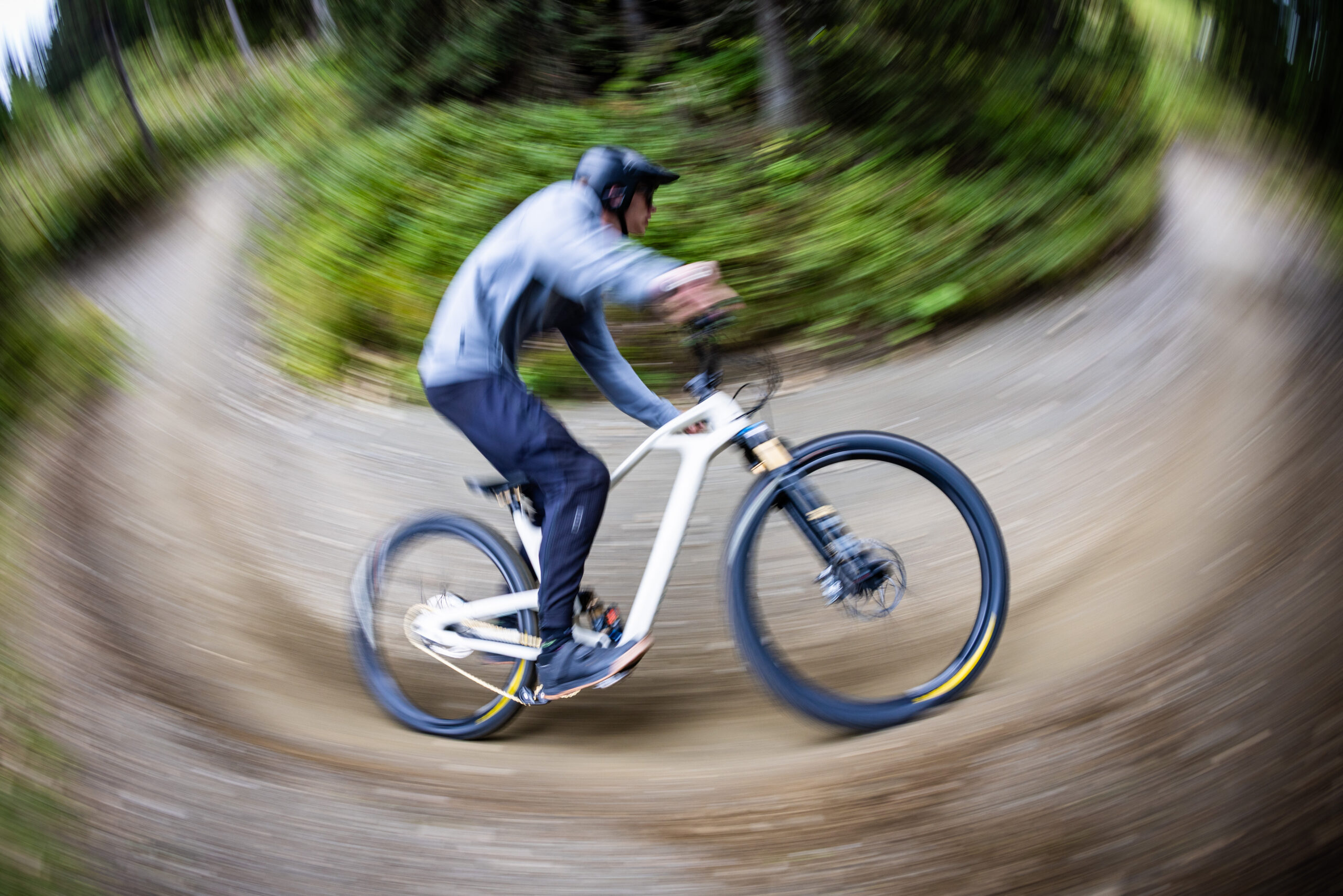
If you have spent time on current eMTBs, you already know the category has split in two. Lightweight assist bikes have sharpened handling and reduced bulk, while full-power machines still own the conversation when steep climbs, long descents, and repeat laps are the whole point. This full power eMTB platform guide is for riders who care less about marketing labels and more about how a bike behaves under real load, real speed, and real terrain.
A full-power platform is not just a motor with more torque. It is a complete systems decision. Battery size changes frame packaging. Weight distribution changes suspension demands. Chassis stiffness, chainstay length, anti-squat, and head tube angle all feel different once you add sustained power and a heavier sprung mass. The best bikes are the ones engineered as complete platforms from the start, not standard mountain bikes adapted around a drive unit.
What a full power eMTB platform really means
In practical terms, a full-power eMTB platform is built around maximum support and meaningful battery capacity. That usually means torque in the upper tier of the category, enough energy storage for long rides or repeated high-output climbing, and a frame architecture designed to carry that mass without feeling dead or vague.
That matters because the riding loads are different. A full-power bike sees harder acceleration out of corners, more frequent braking from higher average speeds, and more climbing traction events on technical pitches where rider input and motor input overlap. If the platform is not balanced, you feel it quickly. Front wheels wander. Rear suspension stiffens under power. The bike becomes stable in a straight line but reluctant to change direction.
A good platform avoids those compromises. It should climb with calm front-end behavior, put power down without excessive suspension interference, and still feel composed when speeds rise on rough descents. Weight is part of the equation, but layout matters more than the number on a scale by itself.
Full power eMTB platform guide to motor and battery choices
Most buyers start with the motor, which makes sense, but it is rarely the whole story. Peak torque figures are useful only when matched with software calibration, engagement feel, noise level, drag above assist limit, and thermal consistency on long climbs.
Some motors feel aggressive the moment you touch the pedals. Others build support with more restraint and better modulation. For technical climbing, that distinction is significant. Too much immediate surge can break traction on roots and rock steps. Too little response can leave the bike feeling flat and delayed when timing matters. The right character depends on where and how you ride, but refined power delivery usually wins over headline force.
Battery capacity follows the same logic. More watt-hours increase range, but they also increase mass and affect the frame’s center of gravity. For riders doing sustained mountain days, that trade is usually worth it. For shorter, high-intensity rides, a slightly leaner system can improve liveliness without creating range anxiety. The point is not to chase the biggest battery available. It is to choose a platform whose intended use matches your actual riding.
A well-integrated system also matters for serviceability. Battery removal, charging access, cooling, sealing, and long-term replacement support are not glamorous topics, but they shape ownership just as much as ride quality does.
Geometry is different on a full-power bike
Geometry numbers do not mean exactly the same thing on a full-power eMTB as they do on an analog bike. Extra mass and assisted climbing change the dynamic window. A bike can carry a slightly more gravity-oriented setup and still remain highly usable on the way up.
That said, there is still a balance to strike. Very long chainstays can improve climbing composure and traction, but they may reduce agility in tighter terrain. Very slack front-end geometry can calm the bike at speed, but if stack, reach, and weight distribution are not carefully resolved, the front tire can become vague on flatter trail or loaded turns.
The strongest platforms tend to deliver stability without feeling oversized. They place the rider in a centered position, keep front-wheel weighting predictable, and let the rear wheel track under power rather than skipping through technical climbs. Small geometry decisions become more noticeable when a motor is amplifying your pace and carrying you into the next section faster than on an acoustic bike.
Suspension kinematics matter more than many riders think
On a full-power eMTB, suspension design cannot be treated as a secondary feature. The bike is heavier, the loads are higher, and the rider spends more time seated and applying torque on rough climbs. That puts a premium on kinematics that preserve traction without turning the rear end into a wallowy mess.
Anti-squat is a good example. Too little, and the bike can feel vague and inefficient under power. Too much, and the suspension may resist movement at exactly the moment the rear wheel needs to stay connected. The best tune is not universal. It depends on travel category, intended speed, and the behavior of the motor system. But the principle is simple: support is valuable, grip is essential.
Progression and damping also need to suit the platform. A full-power bike should resist harsh bottom-outs and maintain composure through repeated impacts, yet still feel active enough to generate traction at lower speeds. That range is not easy to achieve. It requires a frame with coherent leverage characteristics and suspension parts chosen for more than spec-sheet prestige.
Weight is not the enemy. Poor weight distribution is.
Weight remains one of the most over-discussed and under-examined topics in the segment. Yes, lighter bikes accelerate and change direction more easily. But on a full-power eMTB, total weight alone tells you very little unless you know where that mass sits and how the chassis manages it.
A low, centered battery and a compact motor package can make a bike feel far more precise than a lighter bike with awkward mass distribution. Likewise, torsional stiffness has to be judged carefully. Too little stiffness and the bike feels imprecise in loaded corners. Too much, and it can become harsh, especially when combined with heavier wheels and tires.
This is where premium platform design starts to separate itself from commodity production. The question is not whether the bike is light for its category. The question is whether the frame, drive system, and suspension work together so the bike feels planted, calm, and deliberate rather than simply heavy.
Drivetrain design changes the ownership experience
Conventional derailleur drivetrains still dominate the category, but they are not always ideal on high-torque eMTBs ridden hard in poor conditions. Added motor load, chain growth, impact exposure, and frequent shifting under stress all accelerate wear.
That is why serious riders increasingly look at alternative transmission layouts, especially if they value durability and quieter operation. Gearbox-driven systems with transmisión por correa bring real advantages: reduced maintenance, improved impact protection, and more stable unsprung mass because the heaviest transmission components sit within the frame rather than at the rear wheel. The trade-off is that ride feel, gear steps, and initial cost differ from what many riders know.
For some buyers, a conventional drivetrain remains the right choice because it is familiar, widely supported, and easy to tune trailside. For others, especially those riding wet, rocky, high-mileage terrain, low-maintenance systems make a strong case. What matters is choosing a platform that reflects your tolerance for service intervals as much as your appetite for performance.
How to judge a platform beyond the spec sheet
This is where many buying decisions go wrong. Components can be changed. A weak platform cannot. Focus first on frame architecture, motor integration, suspension behavior, and service logic. After that, look at the build.
A serious full-power platform should feel coherent. The bike should corner with commitment, climb without nervous front-end movement, and remain quiet under load. Cable routing, protection, battery access, hardware quality, and bearing layout all deserve scrutiny. Premium pricing only makes sense when those details are resolved properly.
For experienced riders, there is also value in looking at where and how the bike is developed. Bikes designed around alpine terrain often reveal a different set of priorities: sustained descending stability, cooling on long climbs, stronger chassis control, and practical durability rather than showroom novelty. That thinking tends to produce bikes with fewer gimmicks and better long-term satisfaction.
INSTINCTIV approaches this category with that exact mindset, building exclusive platforms in Europe for riders who expect engineering depth, not just assist power.
The right full-power eMTB platform depends on your riding
There is no universal best choice. A rider doing all-day mountain missions will prioritize battery capacity, cooling stability, and composed geometry. A rider focused on technical trail loops may accept less range for sharper handling. An enduro rider might prefer more travel and firmer chassis support, while a mixed-terrain rider may value efficiency and lower maintenance above all else.
That is why the platform matters more than the headline category. Full-power is not a personality trait. It is an engineering framework. The best bikes in this segment are the ones that make high assistance feel natural, controlled, and worth having once the trail gets rough and the elevation stacks up.
Choose the bike that still feels precise on the third big descent, still climbs cleanly when traction is poor, and still makes sense after a full season of hard use. That is usually the platform worth owning.