



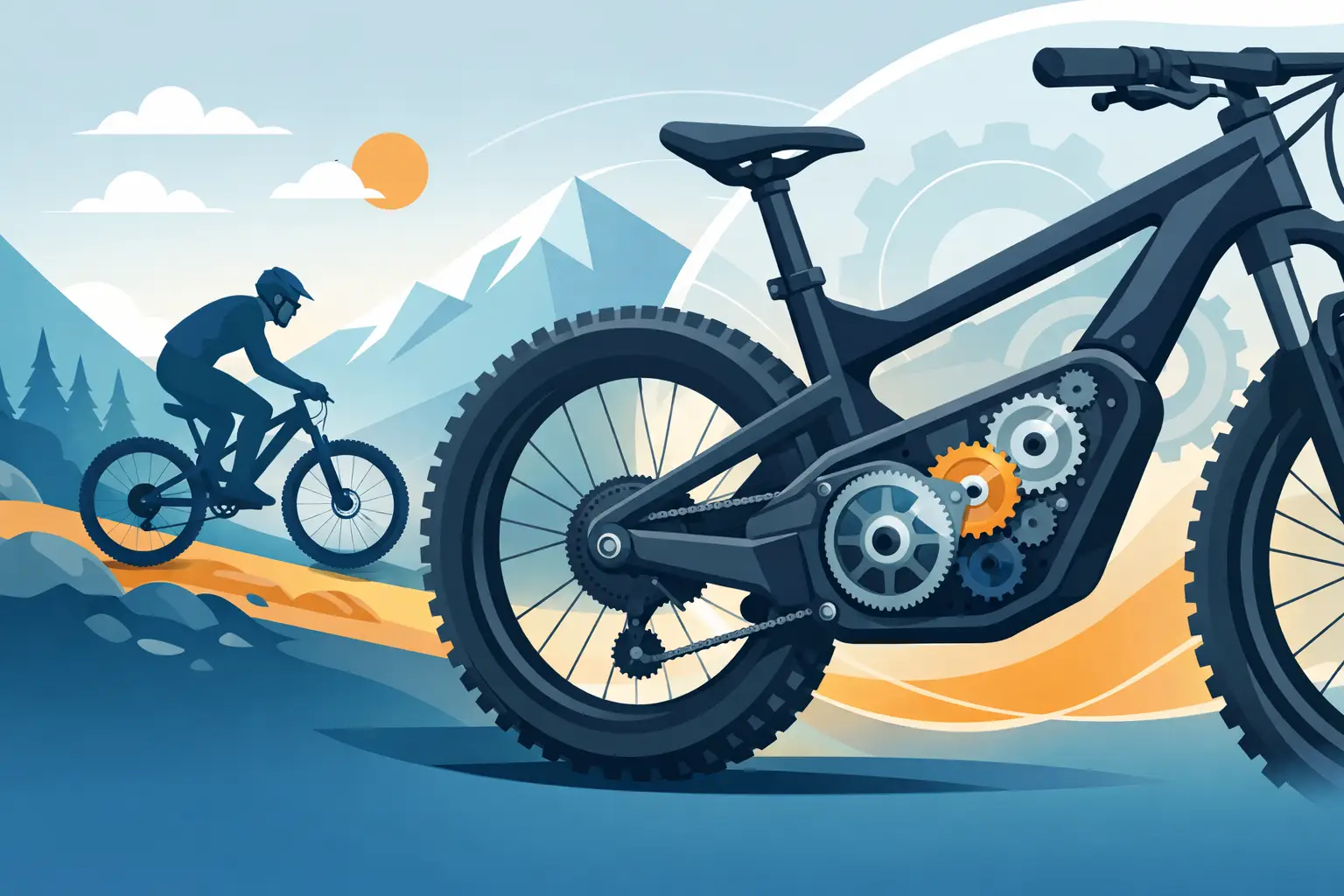
A hard alpine descent is a good place to stop romanticizing conventional drivetrains. When the trail is rough, wet, and fast, a derailleur hanging near the ground starts to look like exactly what it is – an exposed, wear-prone mechanism doing a difficult job in the worst possible location. That is where gearbox MTB advantages explained in plain engineering terms becomes useful, because the case for a gearbox is not fashion or novelty. It is about how a mountain bike behaves under load, over time, and in demanding terrain.
For experienced riders, the real question is not whether a gearbox is different. It obviously is. The question is whether that difference improves ride quality enough to justify the change in layout, setup, and cost. In the right platform, the answer is yes.
Gearbox MTB advantages explained in real riding terms
The first advantage is protection. A gearbox moves the transmission into the frame, away from rock strikes, mud, water spray, and crash damage. That matters more the harder you ride. On technical enduro terrain or long days in mixed conditions, the exposed derailleur remains one of the most vulnerable parts on any mountain bike. A sealed gearbox dramatically reduces that risk.
The second advantage is consistency. A derailleur drivetrain performs best when it is clean, straight, and properly adjusted. A gearbox is far less sensitive to contamination and alignment issues because the gearing mechanism sits inside a protected housing. Paired with a Riemenantrieb, the whole system becomes notably less fussy. There is no cassette collecting grit, no derailleur jockey wheels dragging through mud, and no chain slap battering the rear triangle.
The third advantage is how the bike carries its weight. Centralizing drivetrain mass around the bottom bracket changes the dynamic behavior of the chassis. Instead of adding weight to the rear wheel through a cassette, derailleur, freehub body, and chain movement, the mass sits lower and closer to the bike’s center. That can improve suspension response because the rear wheel has less unsprung mass to control.
This is one of the least understood benefits of a gearbox bike. It is not only about durability. It is also about how the rear suspension tracks the ground when speeds rise and impacts stack up.
Why mass centralization changes the ride
Mountain bikes respond strongly to where weight is placed, not just how much there is. A gearbox system may not always win the scale comparison against a premium derailleur setup, but it often changes the distribution in a more useful direction. With less weight concentrated at the axle, the rear suspension can react with less inertia fighting it.
On rough descents, that can translate into better small-bump sensitivity and a calmer rear end. The wheel recovers faster after repeated hits, and the bike can feel more composed when the trail gets chaotic. Riders coming from high-end derailleur bikes often notice this as a quieter, more settled feel rather than one dramatic moment. The benefit shows up over an entire descent, not just on paper.
There is also a handling element. A lower, more centered transmission mass can make the bike feel planted through turns and less affected by rear-end chatter. On fast natural trails, that contributes to the kind of stability serious riders tend to value most – not deadness, but controlled composure.
Lower maintenance is not a small benefit
For riders who put in real mileage, maintenance is performance. A drivetrain that needs regular cleaning, indexing, hanger checks, chain replacement, cassette replacement, and derailleur inspection is not simply a workshop issue. It affects reliability, cost of ownership, and confidence before a trip or race.
This is where gearbox MTB advantages explained properly should avoid oversimplifying. A gearbox is not maintenance-free. It still requires service intervals, and belt setup needs to be correct. But the maintenance profile is far cleaner and more predictable. Oil changes are straightforward. Belts last well. Gear selection remains stable because there is no derailleur gradually drifting out of adjustment after impacts or contamination.
For riders in wet climates, bike parks, or alpine terrain, the difference becomes especially meaningful. Instead of constantly managing drivetrain wear from grit and water, you spend more time riding and less time chasing crisp shifting.
That matters on premium bikes because ownership should reflect the level of engineering invested in the platform. A sophisticated bike that remains mechanically calm after ugly conditions has a clear advantage over one that demands constant attention.
Shifting behavior is different – and often better
A gearbox does not shift like a derailleur, and that is exactly the point. Depending on the system, it can allow shifting while stationary, and electronic actuation can make shifts highly precise. On technical terrain, that creates practical advantages that are easy to appreciate.
If you stall on a steep climb, selecting the right gear before restarting is far easier with a gearbox than with a derailleur under awkward chain tension. In repeated technical transitions, the ability to reset gearing without pedaling can save energy and reduce mistakes.
There is also a refinement advantage. With a quality gearbox and belt setup, drivetrain noise drops significantly. You lose much of the metallic chatter associated with chain movement, cassette interaction, and chain slap. The bike feels quieter and more composed. For experienced riders, silence is not cosmetic. A quiet bike makes it easier to read tire grip, suspension feedback, and trail speed.
That said, gearbox shifting has its own feel. Some systems prefer a slight reduction in pedal load during shifts. Riders used to forcing hard derailleur shifts under power may need a short adaptation period. The reward is a transmission that remains accurate and mechanically protected over the long term.
Trade-offs serious riders should understand
A gearbox is not the automatic answer for every bike or every rider. Cost is one factor. Engineering a proper gearbox frame is complex, and the complete system sits firmly in the premium category. If initial purchase price is the only metric, a conventional drivetrain will usually look easier to justify.
There is also the matter of ride preference. Some riders like the familiar immediacy and low overall weight of a top-tier derailleur setup, especially in cross-country or lighter trail applications where impact exposure is lower and service demands are more manageable. In those cases, the gains from a gearbox may be less decisive.
Frame design matters as well. A gearbox only delivers its full advantages when the chassis is built around it intelligently. Suspension kinematics, belt line management, frame stiffness, and overall packaging all need to work as one system. A gearbox added as a novelty is one thing. A gearbox integrated from the beginning as the core of a high-performance platform is something else entirely.
That distinction is important because premium riders are not buying concepts. They are buying execution.
Where the gearbox makes the most sense
The strongest use case is aggressive trail, enduro, and all-mountain riding where terrain is rough, weather is variable, and reliability matters as much as outright speed. It also makes a great deal of sense on eMTBs, where drivetrain loads are higher and the durability benefits of a sealed transmission become even more valuable.
For riders who keep bikes for years rather than one season, the ownership case gets stronger. Lower wear, fewer consumables, better protection, and more stable performance all add up. The gearbox starts to look less like a niche curiosity and more like a serious solution to long-standing drivetrain compromises.
This is one reason boutique engineering has led the category. Brands willing to build around the system rather than around market convention can extract more from it. On a purpose-built platform like the INSTINCTIV Kodiak, the gearbox is not there for talking points. It is there because central mass, low maintenance, frame integration, and controlled suspension behavior create a better bike for hard riding.
Gearbox MTB advantages explained without the hype
The cleanest way to view a gearbox MTB is this: it replaces an exposed, maintenance-heavy drivetrain with a protected, centralized transmission that can improve durability, reduce workshop time, calm the chassis, and make the bike feel more composed in demanding terrain. Those are meaningful gains, not marketing abstractions.
It is still a premium solution, and not every rider needs one. But if your riding regularly includes rock strikes, bad weather, repeated descending, high mileage, or simply a low tolerance for derailleur fragility, the gearbox starts to make a compelling amount of sense.
The best bike technologies do not shout. They remove problems so thoroughly that going back feels strangely outdated. A well-executed gearbox platform has that effect, and once you notice it on the trail, it is difficult to ignore.